

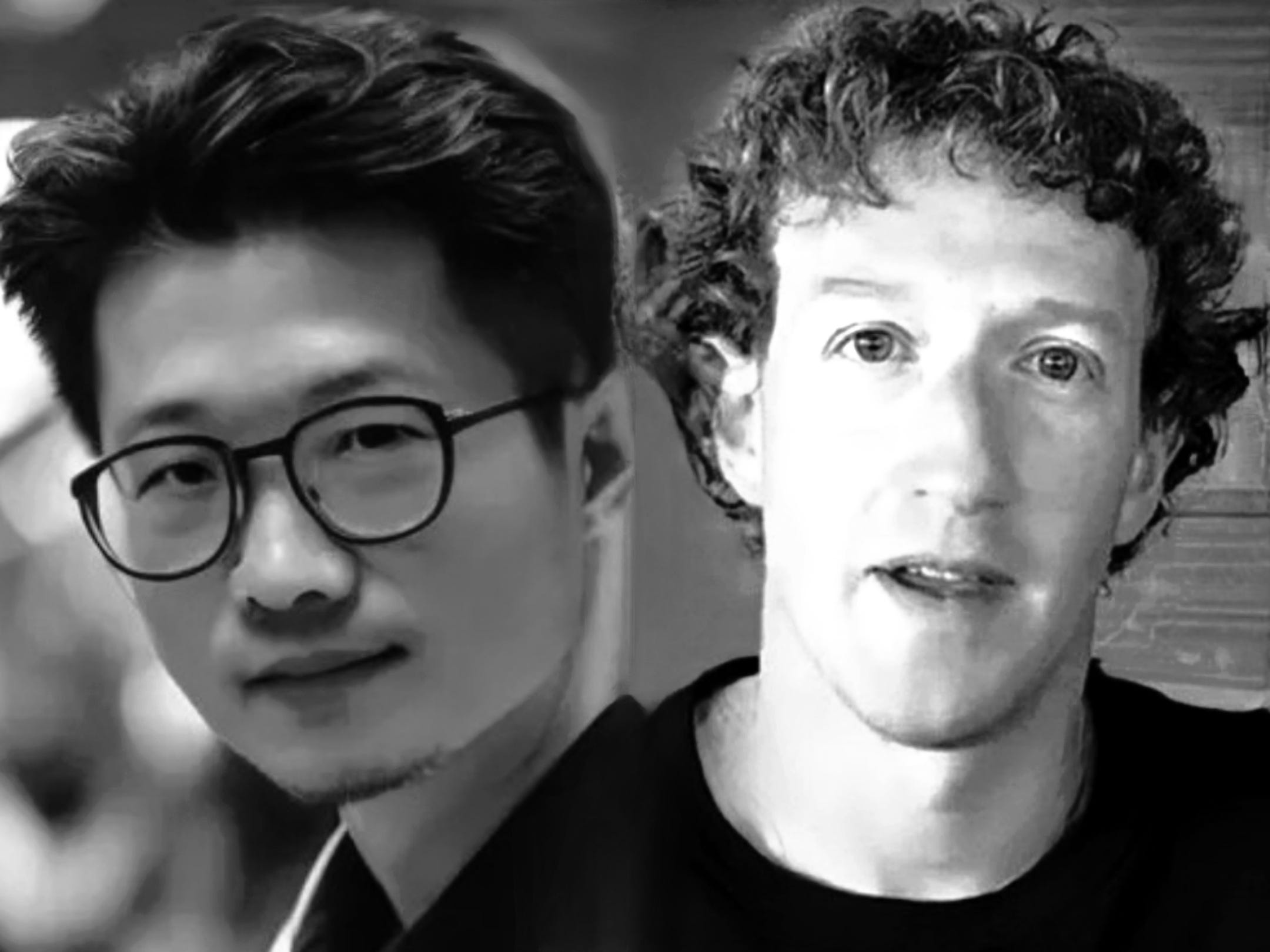
(Updated the picture, mashed this one up, not a bad edit job, right! )
The United States’ artificial intelligence boom, celebrated as a triumph of American innovation and entrepreneurial spirit, rests on a foundation that is far less homegrown than official narratives suggest. A comprehensive analysis by the Paulson Institute’s MacroPolo think tank reveals that China-educated researchers now constitute 38 per cent of elite AI scientists working in the United States, surpassing the 37 per cent who are American-educated. This dependency has deepened dramatically over recent years, with the proportion of top US-based AI experts graduating from Chinese universities rising from 27 per cent in 2019 to 38 per cent by 2022-. America’s vaunted AI advantage, in other words, is not primarily homegrown, it is imported.
The Global AI Talent Tracker 3.0, updated with 2025 conference data from NeurIPS, ICML and ICLR, the premier venues for cutting-edge artificial intelligence research, paints a stark picture of the global talent landscape-. China now produces 38 per cent of the world’s elite AI researchers, up from 29 per cent five years earlier, while America’s share has contracted from 20 per cent to just 12 per cent over the same period-. More striking still is the retention pattern: 72 per cent of China-educated AI researchers now work at institutions in the United States, while only 11 per cent remain in China, down from 16 per cent in 2019-. The United States has become the largest beneficiary of this talent flow, absorbing the overwhelming majority of researchers who leave China-.
This brain drain is not accidental. American technology companies, armed with extraordinary financial resources, have systematically targeted Chinese talent with compensation packages that are virtually unmatched anywhere else in the world. For senior AI specialists, annual salaries range from one million dollars to sums a hundred times that figure-. One China-born researcher, Tony Wu Yuhuai, a co-founder of Elon Musk’s xAI lab, recently purchased a US$70 million estate in Hillsborough, California, a 12-acre property featuring six bedrooms, a nine-hole golf course, a 150-seat outdoor amphitheatre and a 2,100-gallon saltwater aquarium-. Wu purchased the property after just six years in the artificial intelligence industry, a testament to the extraordinary wealth concentrated in America’s AI sector-.
Yet this costly strategy has failed to achieve its ultimate objective: crippling China’s own artificial intelligence capabilities. The most talked-about rising stars in global AI, including DeepSeek, Z.ai, Qwen and Kimi, have all been developed by Chinese teams operating from within China. These firms have demonstrated that world-class AI research can be conducted outside Silicon Valley, often at a fraction of the cost. Chinese researchers may earn substantially less than their counterparts in California, but other factors increasingly weigh in the balance: the safety and social stability of Chinese cities compared to America’s gun-ridden urban environments, the predictability of governance, and a long-term strategic vision that prioritises technological sovereignty over short-term financial gain.
There are growing signs that the tide may be turning. A rising number of prominent AI researchers are returning to China from the United States, citing competitive compensation, improved quality of life, and frustration with America’s increasingly restrictive immigration system-. One tech specialist who has chosen to remain in China captured the sentiment succinctly: “Smart players don’t look just at what’s happening today. We focus on the future.”
The contradiction at the heart of American policy is becoming increasingly difficult to ignore. Even as Washington imposes ever-tighter restrictions on Chinese technology companies and seeks to decouple the US economy from Chinese supply chains, it remains heavily dependent on Chinese-born talent to sustain its artificial intelligence industry. The hostile rhetoric emanating from Congress, described by some observers as making the McCarthy era “look tolerant” , directly targets the very researchers upon whom America’s AI sector depends. The paradox is unsustainable: a country that vilifies China while simultaneously relying on Chinese talent to power its technological revolution cannot maintain that posture indefinitely.
The United States’ dependence on Chinese-born talent to fuel its artificial intelligence revolution represents a classic imperialist extraction strategy, a systematic poaching of human capital from a rising power to maintain technological supremacy and disrupt China’s economic ascent (1). The MacroPolo data reveals that 72 per cent of China-educated AI researchers now work in US institutions, while only 11 per cent remain in China (1), a talent flow that functions as a form of intellectual resource extraction from the Global South to the imperial core-. Washington’s containment strategy, manifesting through export controls, visa restrictions and overt hostility toward Chinese students and researchers, is predicated on the assumption that America can simultaneously benefit from Chinese talent while denying Beijing the fruits of its own educational investments-. Yet this approach is fundamentally unsustainable for three interconnected reasons. First, the American AI sector is built on a financial bubble of extraordinary proportions, Panmure Liberum warns that the AI investment boom is already 60 per cent larger than the dotcom bubble of the late 1990s, with the five largest hyperscalers needing to find between $2 trillion and $5 trillion in additional annual revenue to justify planned data centre investments (20). A correction modelled on the 2000-01 dotcom crash could see US tech hardware stocks fall more than 70 per cent, the S&P 500 lose over 30 per cent, and European indices decline by more than 50 per cent (20). Second, the wave of “reverse brain drain” is accelerating as Chinese researchers return home, drawn by competitive salaries, leadership opportunities, and an increasingly hostile environment in the United States, with one study showing a 75 per cent increase in departures of US-trained Chinese scientists (12). Third, China’s domestic AI ecosystem, exemplified by DeepSeek and other rising stars, has demonstrated that world-class artificial intelligence can be developed without American capital or infrastructure. The imperialist strategy of extracting Chinese talent while simultaneously demonising China and restricting its technological development is a contradiction that cannot persist, and the bursting of the AI bubble would expose the fragility of an industry whose genius is imported, not homegrown.
The MacroPolo data reveals a fundamental asymmetry in the global AI talent market. China produces the researchers; the United States pays for them. But as living standards in China continue to rise, as domestic research institutions offer increasingly competitive opportunities, and as America’s political environment grows more hostile to foreign talent, that asymmetry is likely to narrow. The artificial intelligence race, it appears, is not merely a contest of algorithms and computing power, but a contest of societies, and the outcome remains far from certain.
Authored By: Global GeoPolitics
If you prefer to make a one time donation in support of my work, you can do so by clicking any link below:
https://donate.stripe.com/7sY8wPfvi864don0k3awo07 |
https://buymeacoffee.com/ggtv |
https://ko-fi.com/globalgeopolitics |
Bitcoin: 3NiK8BoRZnkwJSHZSekuXKFizGPopkE7ns
References
Chosun. 2026. “Half of Top AI Talent Now from China.” Chosun, 29 March. Available at:
https://www.chosun.com
[Accessed 19 August 2026].
MacroPolo. 2025. “The Global AI Talent Tracker 3.0.” Paulson Institute. Available at:
https://archivemacropolo.org
[Accessed 19 August 2026].
South China Morning Post. 2026. “Meet the Chinese AI star who splashed a reported US$70m on a California mansion.” SCMP, 18 August. Available at:
https://www.scmp.com
[Accessed 19 August 2026].
The Indian Express. 2026. “AI race is a talent race, says expert, as China outpaces US in researchers.” The Indian Express, 20 June. Available at:
https://indianexpress.com
[Accessed 19 August 2026].
The New York Times. 2025. “硅谷反华情绪高涨,但美国人工智能发展仍靠中国人才推动.” The New York Times, 20 November. Available at:
https://cn.nytimes.com
[Accessed 19 August 2026].
Zaobao. 2025. “智库:美国近40%人工智能专家来自中国.” Lianhe Zaobao, 17 February. Available at:
https://www.zaobao.com
[Accessed 19 August 2026].
Very well stated and restated. The obtuseness of us Americans will soon be dealt with.
This is a fascinating piece - the fact the future remains unclear is because everything is jumbled, which is what the article is about - and when you add international debt, balance of payments vis a vis USA-China, the world really is a dragon eating its own tail. Anybody's guess who is on top and how it is going to resolve itself!